How to Identify a Shark Tooth
Learn the main details collectors look for, including the root, crown, tip, edges, serrations, bourlette, color, and natural fossil wear.

Example tooth: the interactive anatomy guide uses a fossil megalodon shark tooth to show common identification features.
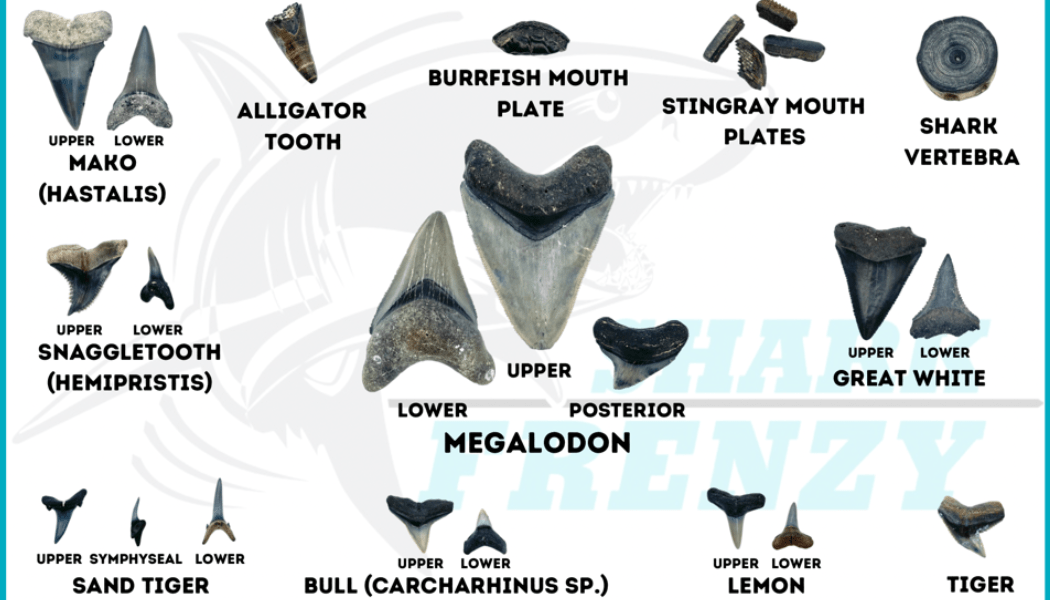
Shark Tooth Identification Sheet
This visual reference sheet gives collectors a quick way to review shark tooth parts and identification clues. Open or download the PNG to keep it handy while comparing fossil teeth.
Key details that help with identification
These clues are a strong starting point. Exact species identification takes comparison, because different sharks can have similar tooth shapes.
Look closely along the edge. Serrations can be fine, coarse, worn down, or missing from certain species entirely.
Roots can be wide, narrow, flat, angled, split, or worn. A natural root often has texture and small imperfections.
The crown may be triangular, narrow, curved, blade-like, or slanted. This is one of the biggest species clues.
This smooth band near the crown base is not on every tooth, but when present it can be a helpful identification feature.
Real fossil teeth often have chips, rounded tips, worn serrations, or natural surface marks from time underwater or in sediment.
Fossil colors come from minerals in the ground or water. Black, gray, brown, blue, tan, orange, and green tones can all occur.
Common questions when inspecting a shark tooth
What is the first thing to look at on a shark tooth?
Start with the overall shape. A shark tooth may be broad and triangular, narrow and needle-like, curved, slanted, or blade-shaped. Shape is one of the fastest clues for narrowing down possible species.
How do serrations help identify a shark tooth?
Serrations are tiny saw-like edges along the tooth. Some sharks have serrated teeth, while others have smooth edges. If the edges are smooth, that can help narrow the tooth toward species like mako or lemon shark.
What should I check on the root and base?
Look at the root shape, surface texture, and the area where the crown meets the base. Some fossil teeth may show a bourlette, which is a smooth band near the base of the crown.
Can color identify the shark species?
Color can help tell whether a tooth is fossilized, but it usually does not identify the species by itself. Fossil colors come from minerals in the ground or water, so shape and edge details matter more.
When should I compare the tooth to a species guide?
After checking shape, edges, root, tip, and wear, compare the tooth to known species. A species guide helps avoid guessing from one clue alone.
Compare shark tooth species
This page teaches the parts of a tooth. For bull shark, lemon shark, megalodon, tiger shark, mako, great white, sand tiger, and hemipristis comparisons, use the species guide next.